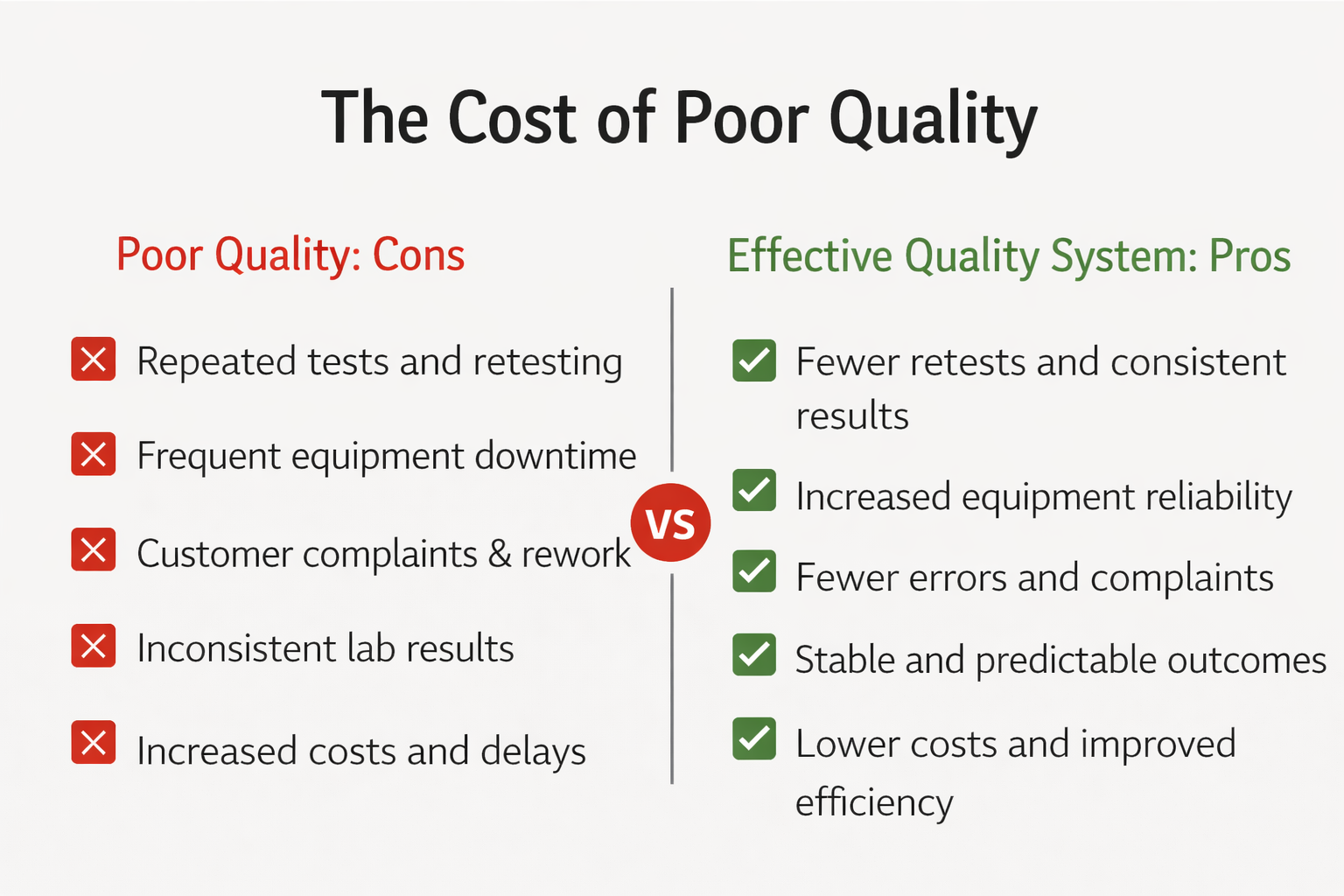
The Cost of Poor Quality The Hidden Expense Most Labs Accept Without Question
By Quentin Basile | LabOpsPro
Walk into almost any laboratory and you’ll see it happening.
A test gets rerun because the result “doesn’t look right.”
An instrument sits idle while someone figures out why it’s down.
A report gets corrected after it’s already been sent out.
A senior technician quietly catches mistakes that no system ever flagged.
None of this raises alarms. It’s just part of the day.
But step back for a moment and look at it differently.
Every one of those moments is a cost. Not just a small inconvenience, but a real, measurable loss of time, money, and reliability. When you add it all together, it becomes something much bigger, something most organizations never fully see.
This is the Cost of Poor Quality, and in many labs, it is one of the largest expenses hiding in plain sight.
What the Cost of Poor Quality Really Looks Like
When people hear “quality costs,” they usually think about audits, documentation, or compliance programs. But the true cost of poor quality has very little to do with paperwork.
It shows up in the work itself.
It’s the extra hour spent retesting a sample that should have been right the first time. It’s the delay that pushes a production decision back. It’s the quiet frustration of fixing the same issue again and again.
Over time, these moments stack up.
In structured studies, the Cost of Poor Quality often lands somewhere between 10 percent and 30 percent of revenue. In laboratory environments, especially those tied to production, that number can be even more significant because every delay ripples outward.
The problem is not that these costs exist. Every operation has some level of inefficiency.
The problem is that most labs accept them as normal.
Where ISO 9001 Comes In, and Where It Falls Short
ISO 9001 is designed to bring structure. It requires you to define your processes, control your documentation, train your people, and respond to issues when they occur. At its core, it is a framework for consistency.
And that matters. Without structure, quality becomes unpredictable.
But here’s where many labs get stuck.
ISO 9001 ensures that a system exists. It does not guarantee that the system is effective.
It is entirely possible to have:
Fully documented procedures
Completed training records
Passed internal audits
…and still deal with constant retesting, recurring issues, and operational drag.
That’s because the system was built to satisfy requirements, not to eliminate failure.
The Difference Between Compliance and Control
There’s a subtle but important shift that separates average labs from high-performing ones.
Compliant systems focus on proving that work was done correctly.
Controlled systems focus on making sure problems don’t happen in the first place.
You can see the difference in how work flows.
In a compliance-driven lab, variation is handled after the fact. Something goes wrong, it gets investigated, a corrective action is written, and the system moves on.
In a controlled lab, variation is watched in real time. Small shifts are caught early. Processes are stable. People are trained not just to follow steps, but to understand when something is off.
One system reacts. The other prevents.
And that difference is where the Cost of Poor Quality starts to disappear.
How Poor Quality Becomes “Normal”
Most labs don’t set out to operate inefficiently. The drift happens slowly.
An SOP gets written once and rarely revisited.
Training becomes a checklist instead of a demonstration of skill.
Equipment is calibrated on schedule, but reliability is never truly measured.
One experienced technician becomes the unofficial safety net for everything.
None of these decisions feel critical in the moment. But together, they create a system that depends more on people than on process.
That’s when the hidden costs start to grow.
You see it in the extra time it takes to get results out.
You see it in the hesitation around trusting data.
You see it in how often problems repeat instead of disappearing.
What Reducing COPQ Actually Looks Like
Reducing the Cost of Poor Quality doesn’t require a complete overhaul overnight. It starts with a shift in focus.
Instead of asking, “Are we compliant?”
Start asking, “Where are we losing time, and why?”
In most labs, a few patterns emerge quickly.
You might notice that retesting is more common than expected. That points to variation in methods or execution.
You might see frequent equipment issues. That suggests a gap between calibration compliance and true reliability.
You might find that training records are complete, but performance varies widely between technicians. That signals a difference between training and competency.
Each of these is an opportunity. Not just to fix a problem, but to remove a recurring cost.
Turning Quality Into a Business Advantage
When quality systems are working the way they should, something interesting happens.
Work becomes smoother.
Results become more predictable.
People spend less time fixing problems and more time moving forward.
From a business perspective, that translates directly into:
Lower operating costs
Faster turnaround times
Greater confidence in decision-making
This is where quality shifts from being a requirement to being an advantage.
And this is also where a well-built system, one that aligns with ISO 9001 but goes beyond it, starts to pay off in ways that are easy to measure.
A Simple Place to Start
If you want to understand the Cost of Poor Quality in your own lab, you don’t need a complex system to begin.
Start by paying attention to a few things over the next couple of weeks:
How often are tests repeated?
How much time is lost to equipment issues?
How many reports are delayed or corrected?
How often do the same problems come back?
Put rough numbers to those.
Even a simple estimate will tell you more than most systems ever track.
Final Thought
Quality is often treated as something you maintain.
In reality, it is something you either control or pay for.
If you’re not actively reducing the Cost of Poor Quality, you are absorbing it, every day, in small ways that add up over time.
The goal isn’t just to pass audits or meet standards.
The goal is to build a system where those everyday problems stop showing up in the first place.
Because once they do, the gains aren’t subtle.
They’re measurable, repeatable, and hard to ignore.
(Optional Section for Bottom of Page)
Work With LabOpsPro
If your lab is dealing with:
High retest rates
Recurring quality issues
Inconsistent training
Equipment downtime
LabOpsPro helps implement systems that reduce risk, improve performance, and exceed ISO standards.
Visit: LabOpsPro.com
Connect: Quentin Basile on LinkedIn