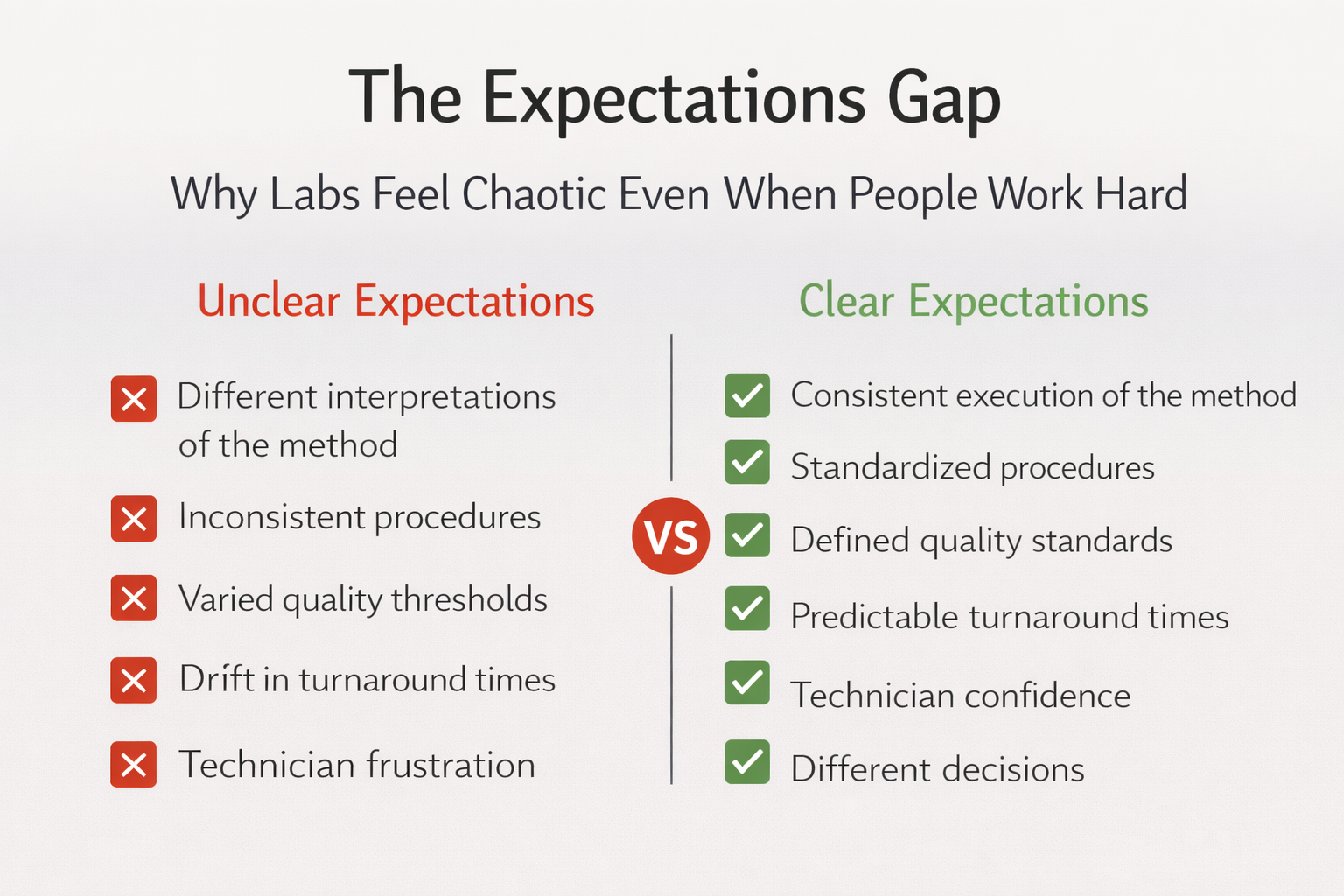
The Expectations Gap: Why Labs Feel Chaotic Even When People Work Hard
Most labs do not suffer from a lack of effort. They suffer from unclear expectations. When technicians receive different answers from different people on how a test should be performed, the system is already failing. Misalignment becomes variation. Variation becomes inconsistency. Inconsistency becomes frustration.
This post breaks down the expectations problem, how to fix it, and the financial risk when expectations are vague.
THE PROBLEM: Every Technician Running A Different Lab
A lab cannot function when every person has a different idea of what “right” looks like.
This is what unclear expectations create
• Different interpretations of the method
• Different setups
• Different steps
• Different quality thresholds
• Different decisions
Turnaround time drifts.
Data becomes inconsistent.
Tribal knowledge replaces structure.
Supervisors spend their time firefighting instead of leading.
Technicians lose trust in the system and in each other.
Technicians do not fail because they lack motivation.
They fail because the standard is vague, hidden, or changing depending on who is asked.
A lab cannot outperform the clarity of its expectations.
HOW TO FIX IT: The Five Elements Of Clear, Functional Expectations
Expectations only work when they are specific, visible, consistent, demonstrated, and reinforced. Anything less creates confusion.
1. Expectations Must Be Specific
Instructions like “be accurate” or “run it the usual way” are not standards.
A clear expectation spells out exactly what the technician should do and how it should look.
2. Expectations Must Be Visible
If the standard lives only in a binder or in someone’s memory, it will never guide daily behavior.
Expectations must be accessible at the point of use.
3. Expectations Must Be Consistent
The expectation should not change depending on the shift, supervisor, or senior tech.
Consistency eliminates the confusion that drives improvisation.
4. Expectations Must Be Demonstrated
Technicians learn faster when they see the standard, not just hear it.
A clear expectation includes an example of correct execution.
5. Expectations Must Be Reinforced
Even the strongest expectations fade when not maintained.
Clear reinforcement keeps the standard stable and prevents drift.
When these five elements are in place, the lab becomes predictable, teachable, and repeatable.
THE RISK: The Financial Cost Of Unclear Expectations
Unclear expectations do not only create frustration.
They create risk.
That risk hits the bottom line every single day.
1. Lost Time From Constant Clarification
When technicians must ask for confirmation or redo steps, time slips away in minutes that accumulate across the shift.
Those minutes become hours.
Those hours become full days of lost throughput.
2. Higher Levels Of Rework
Variation leads to mistakes.
Mistakes lead to reruns.
Reruns double labor cost and slow every other test on the schedule.
Rework is not just a quality issue.
It is a financial drain.
3. Inconsistent Data Leading To Wrong Decisions
Even small differences in method execution create variability.
Variability creates doubt.
Doubt slows production decisions or forces operations to make choices without reliable numbers.
This exposes the site to quality risk, energy inefficiency, and shipment delays.
4. Decline In Credibility
When expectations shift from person to person, confidence erodes.
Supervisors stop trusting the numbers.
Production loses trust in the lab.
Leadership questions the system.
Credibility loss is one of the costliest failures a lab can experience.
5. Increased Turnover
Technicians burn out when nothing feels consistent.
Repetitive rework, unclear directions, and correction after correction create frustration that pushes people out the door.
Replacing a technician is far more expensive than establishing clear expectations.
BOTTOM LINE
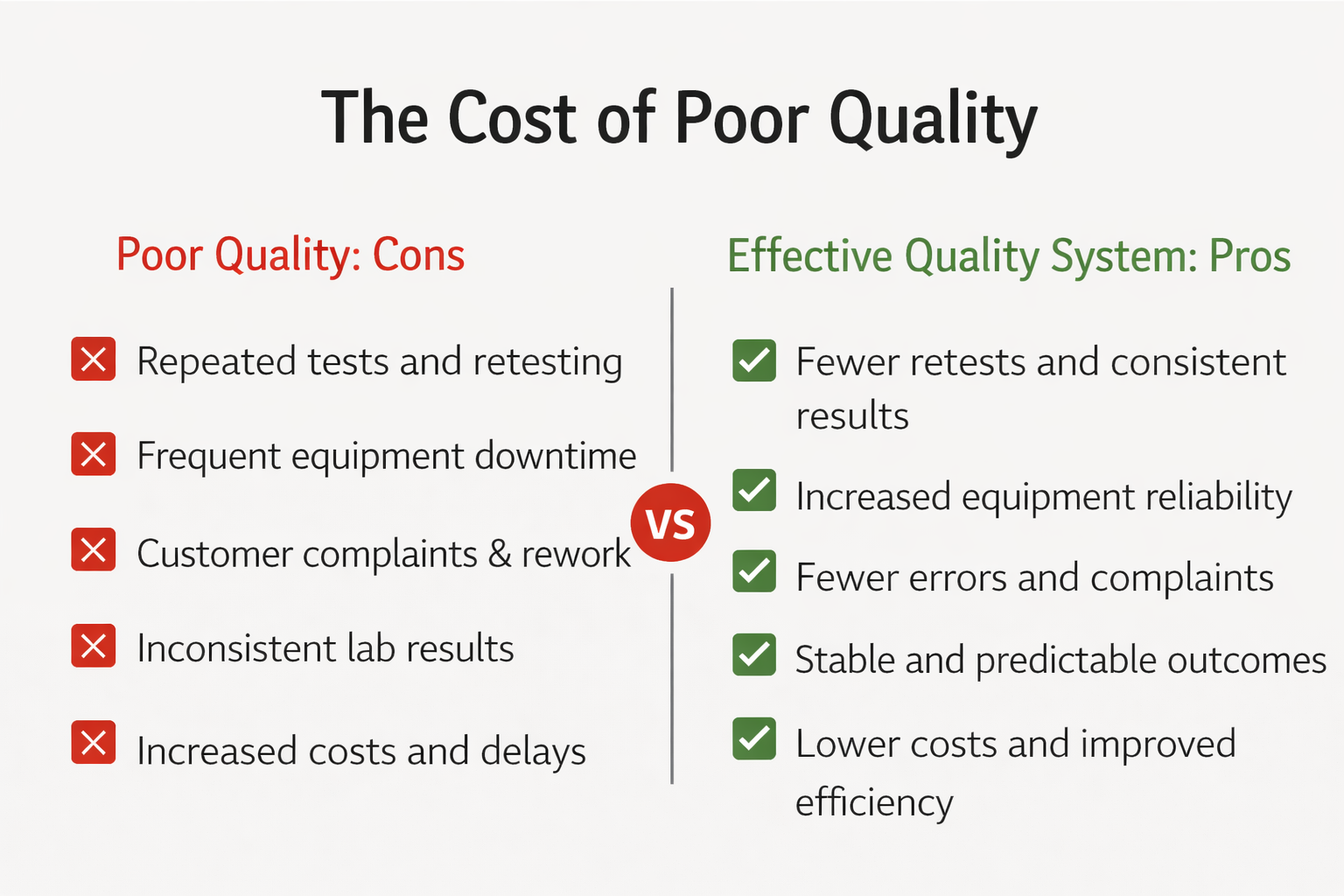
Unclear expectations create chaos, waste time, increase cost, and weaken credibility.
Clear expectations stabilize the lab, sharpen training, reduce rework, and strengthen the plant.
If the lab feels chaotic even when everyone is working hard, expectations are the first place to look.
Fix the expectations, and the entire system improves.
If your lab is dealing with these issues, it will not fix itself. Problems built on unclear expectations or single points of failure only grow more expensive over time. If this sounds familiar, we should talk. A conversation now can prevent months of drift, rework, and financial loss later.
When One Call Out Shuts Down a Lab: The Hidden Operational and Financial Risk
Most petrochemical labs believe they are protected from staffing disruptions. The truth is that many are one unexpected absence away from stalled testing, delayed production, and thousands of dollars in hidden losses. When a single technician calling out causes a cascade of downtime, the problem has nothing to do with attendance. It has everything to do with system design.
This post breaks down the issue, the solution, and the risk behind single-point failures inside lab operations.
THE PROBLEM: A Lab Built On Single Points of Failure
A technician calls out.
A key quality test stops.
Samples pile up.
Production waits on data.
Supervisors make decisions blind.
When only one person knows how to run a critical method, the entire operation becomes fragile. This is not a rare scenario. It is a silent vulnerability in many petrochemical labs.
A system that relies on perfect attendance is a system that will fail without warning.
A resilient lab cannot depend on one person to keep production moving.
HOW TO FIX IT: Five Operational Controls That Eliminate Downtime
Solving the call out problem requires structure, depth, and repeatable training. High-performing labs use these five controls to stay stable even when staffing changes occur.
1. A Cross Training Matrix Based On Current Capability
A reliable matrix reflects what technicians can run today, not what they learned years ago.
Once true capabilities are visible, gaps can be closed quickly and strategically.
2. Method Ownership Without Method Dependency
Each method can have a lead, but no method should rely on only one operator.
A structured rotation ensures multiple technicians can run the test confidently and accurately.
3. Documentation That Removes Tribal Knowledge
If a method only exists in one technician’s memory, the lab is exposed.
SOPs must be clear, complete, and detailed enough for any trained operator to perform the work without improvisation.
4. A Repeating 90 Day Training Cycle
Training cannot be a one-time event.
A quarterly cycle keeps skills sharp, prevents drift, and ensures coverage stays strong across shifts.
5. Redundancy Built Into Every Critical Method
Labs should operate like safety systems.
The most essential tests must have multiple qualified backups to prevent delays and maintain consistency.
When these controls are in place, one absence becomes a non-event instead of a site-wide disruption.
THE RISK: How One Call Out Turns Into a Five-Figure Loss
The financial impact of a call out that halts testing is far higher than most sites realize. The cost shows up in multiple ways:
1. Production Delays
Every hour without data slows operational decisions and pushes production into guesswork.
In petrochemical environments, even short delays can cost thousands.
2. Backlogged Samples
When a method stops, the entire workflow slows.
Outages create hours of catch up, overtime, and increased error rates.
3. Increased Rework
Thin coverage leads to inconsistency.
Rework doubles labor cost and consumes instrument time that should support production.
4. Loss of Confidence From Operations and Leadership
Repeated downtime damages credibility.
Once trust declines, the lab loses influence, support, and operational authority.
5. Turnover From Burnout
When one person carries a critical method, stress rises fast.
Replacing a technician costs far more than building proper redundancy.
A single absence should never cost the site thousands of dollars, damage credibility, or push production into crisis mode.
The risk is preventable. The solution is operational design, not luck.
BOTTOM LINE
A lab that hinges on one technician is not reliable.
It is vulnerable.
Cross training, documentation, redundancy, and structured training cycles transform the lab from fragile to stable. When the system is strong, the plant remains strong.
A resilient lab does not depend on perfect attendance.
It depends on systems built to withstand reality.
If your lab slows down every time one technician is out, that is a sign the system is carrying more risk than it should. Single point failures do not stay small. They grow into costly delays, backlogs, and credibility problems. If this describes your operation, we should talk. A conversation now can prevent the next shutdown from happening.
5 Signs Your Lab Needs a System Overhaul (and How to Fix It)
Is your lab stuck in reactive mode? Discover 5 signs it’s time to overhaul your systems — plus practical steps to streamline and scale with clarity.
5 Signs Your Lab Needs a System Overhaul (and How to Fix It)
By Lab Ops Pro | Lab Consulting, SOP Development, and Compliance Support
1. Your SOPs are outdated or missing altogether
If your team relies on tribal knowledge, sticky notes, or buried PDFs to run day-to-day tasks, you’re not alone. Many labs evolve quickly — but the systems don’t always keep up.
👉 Fix it: A systemized SOP refresh not only supports training but reduces costly mistakes and audit risk.
2. New hires take too long to get up to speed
When onboarding takes weeks instead of days, or training is inconsistent from person to person, it’s a sign your lab is operating on memory, not process.
👉 Fix it: Create cross-functional onboarding workflows that shorten training time and help new hires contribute faster.
3. You’re always preparing for an audit
If “audit readiness” means scrambling for documentation, retraining staff, or rewriting procedures last minute — your systems aren’t audit-aligned.
👉 Fix it: Building a compliance-minded lab from the start is easier (and cheaper) than backtracking when regulators are on the way.
4. You have great people, but chaos keeps slowing them down
Your lab techs and leads may be brilliant — but if poor documentation, unclear roles, or messy workflows keep causing problems, talent isn’t enough.
👉 Fix it: Operational clarity unlocks your team’s full potential. Structure doesn’t restrict performance — it supports it.
5. Everything feels reactive
If your lab is constantly “firefighting” — fixing issues after they happen — it’s a sign your systems aren’t proactive enough.
👉 Fix it: A system overhaul gives you better visibility, consistency, and control across every part of your lab.
🔬 Ready for Your Lab to Run Without the Chaos?
Lab Ops Pro helps industrial and manufacturing labs streamline their operations with:
• SOP cleanup and creation
• Onboarding and cross-training workflows
• Compliance support
• Custom lab system builds
📞 Let’s talk: Book a free discovery call
📦 Or explore our flat-fee service packages
How to Build SOPs Your Lab Techs Will Actually Follow
Tired of SOPs collecting dust? Learn how to write clear, usable SOPs your lab team will trust, follow, and use to drive compliance and efficiency.

How to Build SOPs Your Lab Techs Will Actually Follow
By Lab Ops Pro | Lab Systems Consulting for Industrial & Manufacturing Labs
💡 The Problem: SOPs That Don’t Work
Many labs technically “have” SOPs — but nobody uses them. Why? Because they’re often too vague, outdated, or impractical. When procedures aren’t written for the people doing the work, they get ignored.
In regulated or high-volume labs, that’s a dangerous risk — to safety, efficiency, and audit readiness.
🔍 5 Keys to Creating Effective Lab SOPs
1. Write for the person doing the job
Avoid corporate jargon or overcomplicated language. Use direct, action-based steps like:
✅ “Label the vial with date and initials”
❌ “Ensure proper identification and chronological tracking”
2. Break tasks into simple steps
Techs shouldn’t need to think about what’s next. Every step should be short, logical, and unambiguous — ideally written at an 8th-grade reading level.
3. Include visuals when possible
A quick photo, diagram, or flowchart can often replace several paragraphs of explanation. This helps new hires and supports cross-training.
4. Make sure they reflect reality
Too many SOPs are written by people who used to do the job — or never did. Conduct a process walk with your current techs before finalizing.
5. Build SOPs that evolve
A “set it and forget it” approach doesn’t work. Your SOP system should include regular review, feedback loops, and version control.
🔬 Why It Matters
Clear, usable SOPs:
• Reduce training time for new hires
• Improve audit readiness
• Prevent costly mistakes
• Boost team confidence and performance
👣 Next Steps: Want SOPs That Actually Work?
Lab Ops Pro helps industrial and manufacturing labs create SOP systems that are practical, compliant, and easy to follow.
• SOP creation or cleanup
• Visual templates and workflows
• On-site or remote documentation support
📞 Schedule a free discovery call
📄 Or explore our flat-fee packages
Audit-Proofing Your Lab: A Consultant’s Checklist
Get audit-ready with this expert-backed checklist. Avoid costly violations and streamline your compliance systems before the next inspection hits.
Audit-Proofing Your Lab: A Consultant’s Checklist
By Lab Ops Pro | Lab Systems Consulting for Industrial & Manufacturing Labs
🧯 The Stakes Are High
Whether it’s ISO, FDA, EPA, or internal audits, the moment someone says “audit,” tension spikes. And with good reason — one misstep can lead to:
• Costly shutdowns
• Compliance penalties
• Damaged reputation
• Lost contracts or customers
But here’s the thing: audit panic is preventable.
🔍 Lab Ops Pro’s Audit Readiness Checklist
Use this checklist to identify your lab’s weak points — and fix them before your next inspection.
✅ 1. SOPs Are Updated and Followed
• Last review dates visible?
• Are techs actually following procedures?
• Is version control in place?
🧪 Tip: If SOPs exist just to satisfy paperwork — and not guide daily work — they’ll backfire in an audit.
✅ 2. Training Records Are Current
• Are your training logs centralized?
• Can you prove who’s qualified to do what?
• Is cross-training documented?
🧠 Auditors don’t just care about documents — they care that your people understand and follow them.
✅ 3. Corrective Actions Are Tracked
• Do you have a system for recording and resolving errors or deviations?
• Is root cause analysis documented?
🔍 “We fixed it” isn’t enough — show your improvement process.
✅ 4. Equipment Calibration and Maintenance Logs Are Accessible
• Are your balances, ovens, and analytical instruments within spec?
• Are logs complete, legible, and organized?
🛠️ Missing logs are red flags. Regular audits fail because of paperwork, not performance.
✅ 5. Safety & Regulatory Compliance Is Not Just on Paper
• Are MSDS sheets up to date?
• Is PPE compliance consistent?
• Are emergency procedures visible and practiced?
🚨 Auditors will observe your lab in action — not just flip through binders.
⚙️ Don’t Just Pass. Be Confident.
An audit shouldn’t feel like a gamble. It should feel like a formality.
Lab Ops Pro works with industrial and manufacturing labs to:
• Clean up SOPs and training systems
• Organize logs and compliance documents
• Train staff on what auditors really want
• Conduct mock audits so you’re always inspection-ready
🔗 Want to Avoid Audit Panic?
✅ Check out our flat-rate consulting packages
Why Your Lab Training Isn’t Sticking (and How to Fix It)
Is your team forgetting training just weeks later? Discover why lab onboarding often fails—and how to build systems that stick.
Why Your Lab Training Isn’t Sticking (and How to Fix It)
By Lab Ops Pro | Lab Systems Consulting for Industrial & Manufacturing Labs
👩🔬 The Problem: Training That Fades Fast
You train your new hires. You even retrain your veterans. And still…
Mistakes happen. Steps get skipped. And nobody can remember what was covered just a few weeks ago.
What’s going wrong?
🔍 4 Reasons Lab Training Fails
1. You’re training too early
If your onboarding sessions happen during information overload, most of it gets lost. Frontload only what’s needed for Day 1, then layer in new skills over time.
2. There’s no structure to follow up
Training is not a one-and-done. Do you have scheduled refreshers? Shadowing opportunities? Or checklists for techs to review?
🧠 Repetition with intention builds real competence.
3. Your SOPs don’t align with training
Are your trainers and your documents saying the same thing? If the SOPs don’t reflect what’s taught (or worse — if they’re outdated), the confusion spreads.
4. You’re not using microtraining
Trying to teach everything in 90 minutes? Won’t work. Break skills into 10-minute modules with hands-on examples. Techs retain more when they do, not when they sit.
💡 The Solution: Build a Training System, Not Just a Session
Effective lab onboarding includes:
• A phased learning approach
• Up-to-date SOPs that match the work
• Visual aids and peer mentoring
• Scheduled review points
🛠️ What Lab Ops Pro Offers
We help labs overhaul their training programs with:
• Custom onboarding workflows
• SOP-driven training alignment
• Cross-training maps for flexibility
• Templates for training logs and tracking
📈 The result? A more confident team, faster productivity, and lower turnover.
🔗 Want Training That Sticks?
✅ Explore our flat-fee training packages