The Expectations Gap: Why Labs Feel Chaotic Even When People Work Hard
Most labs do not suffer from a lack of effort. They suffer from unclear expectations. When technicians receive different answers from different people on how a test should be performed, the system is already failing. Misalignment becomes variation. Variation becomes inconsistency. Inconsistency becomes frustration.
This post breaks down the expectations problem, how to fix it, and the financial risk when expectations are vague.
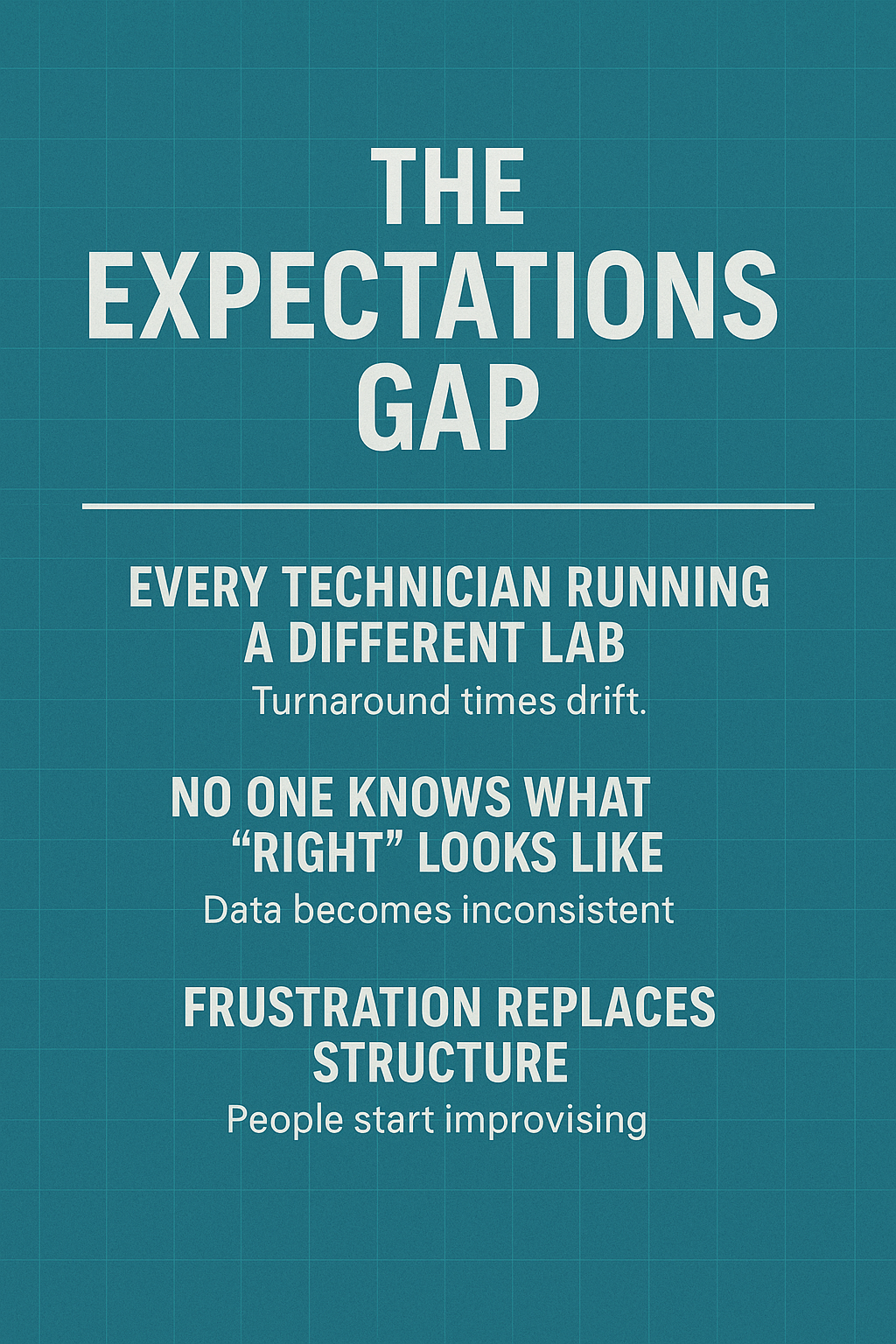
THE PROBLEM: Every Technician Running A Different Lab
A lab cannot function when every person has a different idea of what “right” looks like.
This is what unclear expectations create
• Different interpretations of the method
• Different setups
• Different steps
• Different quality thresholds
• Different decisions
Turnaround time drifts.
Data becomes inconsistent.
Tribal knowledge replaces structure.
Supervisors spend their time firefighting instead of leading.
Technicians lose trust in the system and in each other.
Technicians do not fail because they lack motivation.
They fail because the standard is vague, hidden, or changing depending on who is asked.
A lab cannot outperform the clarity of its expectations.
HOW TO FIX IT: The Five Elements Of Clear, Functional Expectations
Expectations only work when they are specific, visible, consistent, demonstrated, and reinforced. Anything less creates confusion.
1. Expectations Must Be Specific
Instructions like “be accurate” or “run it the usual way” are not standards.
A clear expectation spells out exactly what the technician should do and how it should look.
2. Expectations Must Be Visible
If the standard lives only in a binder or in someone’s memory, it will never guide daily behavior.
Expectations must be accessible at the point of use.
3. Expectations Must Be Consistent
The expectation should not change depending on the shift, supervisor, or senior tech.
Consistency eliminates the confusion that drives improvisation.
4. Expectations Must Be Demonstrated
Technicians learn faster when they see the standard, not just hear it.
A clear expectation includes an example of correct execution.
5. Expectations Must Be Reinforced
Even the strongest expectations fade when not maintained.
Clear reinforcement keeps the standard stable and prevents drift.
When these five elements are in place, the lab becomes predictable, teachable, and repeatable.
THE RISK: The Financial Cost Of Unclear Expectations
Unclear expectations do not only create frustration.
They create risk.
That risk hits the bottom line every single day.
1. Lost Time From Constant Clarification
When technicians must ask for confirmation or redo steps, time slips away in minutes that accumulate across the shift.
Those minutes become hours.
Those hours become full days of lost throughput.
2. Higher Levels Of Rework
Variation leads to mistakes.
Mistakes lead to reruns.
Reruns double labor cost and slow every other test on the schedule.
Rework is not just a quality issue.
It is a financial drain.
3. Inconsistent Data Leading To Wrong Decisions
Even small differences in method execution create variability.
Variability creates doubt.
Doubt slows production decisions or forces operations to make choices without reliable numbers.
This exposes the site to quality risk, energy inefficiency, and shipment delays.
4. Decline In Credibility
When expectations shift from person to person, confidence erodes.
Supervisors stop trusting the numbers.
Production loses trust in the lab.
Leadership questions the system.
Credibility loss is one of the costliest failures a lab can experience.
5. Increased Turnover
Technicians burn out when nothing feels consistent.
Repetitive rework, unclear directions, and correction after correction create frustration that pushes people out the door.
Replacing a technician is far more expensive than establishing clear expectations.
BOTTOM LINE
Unclear expectations create chaos, waste time, increase cost, and weaken credibility.
Clear expectations stabilize the lab, sharpen training, reduce rework, and strengthen the plant.
If the lab feels chaotic even when everyone is working hard, expectations are the first place to look.
Fix the expectations, and the entire system improves.
If your lab is dealing with these issues, it will not fix itself. Problems built on unclear expectations or single points of failure only grow more expensive over time. If this sounds familiar, we should talk. A conversation now can prevent months of drift, rework, and financial loss later.